
NFL Home-Field Advantage: What Three Points Are Worth

Every power rating in football ends the same way. One team is rated above the other, and then three points get added for whoever is at home.
Those three points ride into the preview, the projection and the first number posted on the game. What they are worth is a separate question. Points are a margin, and a bettor is buying a chance.
Where the Three Points of Home-Field Advantage Come From
Home teams win more football games than road teams, and they have done so for as long as the results have been counted. From 2002 through 2010, home teams won over 57 percent of the time.
The reasons are not mysterious: crowd noise on third down, a familiar surface and a body clock that has not crossed three time zones all pull the same way. That is why the hardest buildings to visit are a permanent argument among fans.
Football markets compress all of it into one figure. Three points is the standard home adjustment, and it has outlasted a lot of attempts to replace it.
From a Point Margin to a Win Probability
Final margins do not land anywhere at random, but pile up in a bell shape around the posted number, spread out by a little under 14 points.
That single fact is the whole conversion. Take 13.86 points as the spread of outcomes, start two teams level on talent, then hand one of them the three points for being at home.
The answer is 58.6 percent, leaving 41.4 percent for the road team. Neither figure came from a roster, an injury report or an opinion about the game, and both came out of the shape of NFL scores.
Reading the Market’s Own Home-Field Number
A moneyline pair says the same thing in different notation, with a surcharge attached. A home team favored by three usually shows around -160, with +135 on the road side. Those convert to 61.5 percent and 42.6 percent, which add up to 104.1.
No football game has 104.1 percent of anything to hand out, and the extra 4.1 points are what the book charges for quoting the pair at all.
Stripping that surcharge out leaves the market’s own home number. A two-way or three-way price fed into OVERDOG’s no-vig calculator comes back as a margin-free probability on each side. On -160 and +135 that is 59.1 percent for the home team and 40.9 percent for the road team.
Read backwards through the bell curve, 59.1 percent is a shade over three points. The market’s own home number and the arithmetic land in the same place, which is worth knowing before either gets argued with.
The Same Three Points Are Worth Less to a Big Favorite
A bell curve is steepest in the middle, so where a game already sits decides what three points buy. Off a level game the move is from an even 50 percent to 58.6 percent, a gain of 8.6 points of win probability.
Now hand the same three points to a two-touchdown favorite, where fourteen points is 84.4 percent and seventeen points is 89.0 percent. The curve shows the rest.
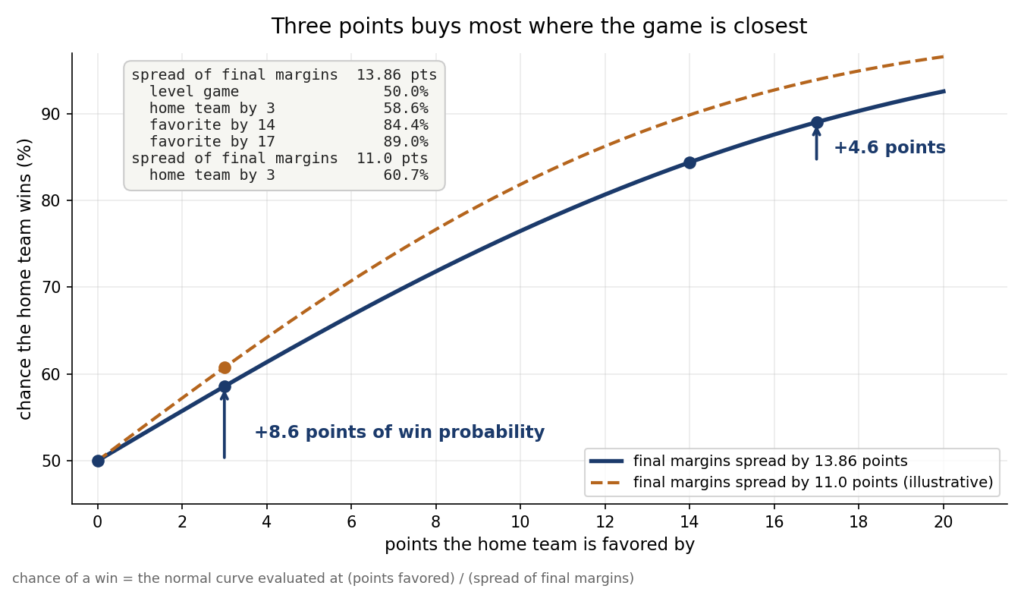
Three points is worth 8.6 points off a level game and 4.6 to a big favorite.
So the same three points are worth 4.6 points of win probability instead of 8.6, which is close to half. A home edge does its real work in the games nobody can separate, and almost none of it in a mismatch.
Home-Field Advantage in a Low-Scoring Game
The spread of final margins is not fixed either. Across the 2002 to 2011 seasons it came out nearer 13.588 points than the figure the older arithmetic used.
Push that number down and three points buys more. At a spread of 11 points rather than 13.86, two level teams become 60.7 percent and the home edge gains another two points of probability.
Wind, cold and a rule change that moves where drives begin all work on that same dial. Anything that squeezes the range of plausible scores makes three points heavier.
Who Pays When a Home-Field Read Keeps Winning
A read on home-field advantage is not a one-game opinion. A bettor who thinks the three points are too cheap in cold-weather divisions backs that same shape of team twenty times a season, and the repetition is what a sportsbook notices.
Every ticket a sportsbook writes is a bet against its own customer. Someone who keeps buying the cheaper half of a number turns into an expense, so the maximum stake gets trimmed, trimmed again, and finally set where the account is not worth using.
Prices reached through OVERDOG come off the Polymarket exchange, where the numbers are quoted by traders rather than by a house. Nobody on that route sits in the bookmaker’s seat. Both sides of the price belong to other bettors, so the venue carries no view on the game and no reason to sort customers by their record.
The cost there is charged beside the price rather than folded into it. OVERDOG bills a flat 1% and Polymarket bills its own fee, so the pair of numbers adds up to 100 instead of 104.1.
No one there decides a bettor has backed one read too often. What limits a large bet is the money other bettors have put up at each price, and that amount is visible before anything is staked.
Three points is a small number to build a season on, and knowing what it buys, and where it stops buying much, is most of what makes it usable.

NFL Draft Diamonds was created to assist the underdogs playing the sport. We call them diamonds in the rough. My name is Damond Talbot, I have worked extremely hard to help hundreds of small school players over the past several years, and will continue my mission. We have several contributors on this site, and if they contribute their name and contact will be in the piece above. You can email me at nfldraftdiamonds@gmail.com