
Pittman’s Pocket HBCU Football Weekend Report: Standout Performances, Offensive Explosions, and Defensive Difference-Makers
By Pittman’s Pocket | HBCU Football Scouting and Player Evaluation
HBCU football continues to showcase the talent, competitiveness, and playmaking ability that deserve greater national recognition. This week’s performances featured explosive rushing production, high-impact passing attacks, dynamic receivers, and defensive standouts making their presence felt across the field.
From Mississippi Valley State’s Josh Brown delivering a three-touchdown rushing performance to Florida A&M’s Armond Parker and Armand Burris connecting for an explosive aerial attack, several players made compelling statements. Meanwhile, Trey Holly continued to produce on the ground for Southern, and defensive contributors across the HBCU landscape demonstrated their ability to influence the outcome of a game.
Here is the latest breakdown from Pittman’s Pocket.
Mississippi Valley State: Josh Brown Delivers Three Touchdowns on the Ground
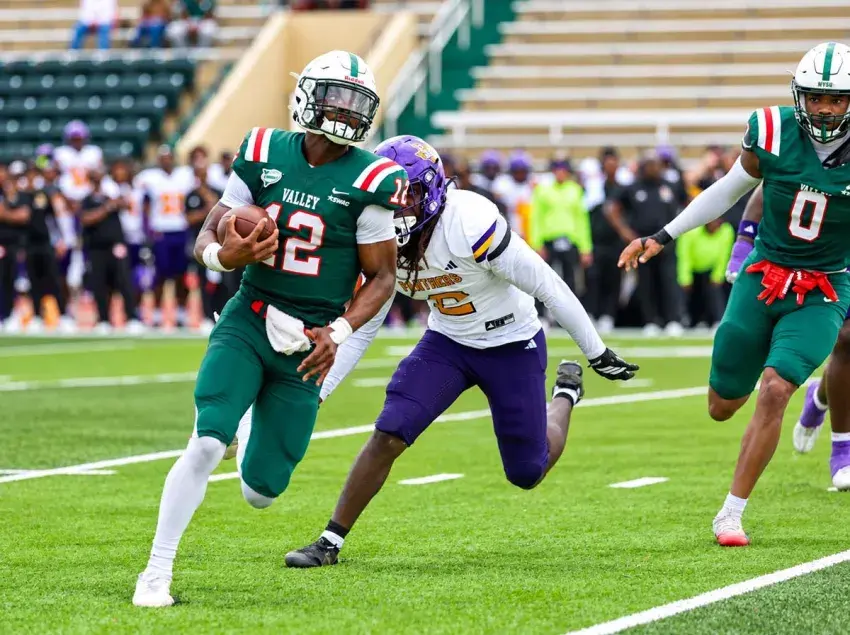
Mississippi Valley State quarterback Josh Brown (#12) delivered one of the weekend’s most productive dual-threat performances, combining efficiency through the air with significant production in the running game.
Brown completed 13 of 25 passes for 144 yards and one touchdown without throwing an interception. However, his most impressive contributions came on the ground, where he carried the football 17 times for 101 yards and three touchdowns, averaging 5.9 yards per carry.
Brown’s ability to generate more than 100 rushing yards while scoring three times demonstrated his value as a playmaker beyond the traditional passing game. His performance highlights the importance of quarterback mobility, physicality, and red-zone execution in an offense.
Scouting takeaway: Brown’s four total touchdowns and 245 combined passing and rushing yards make this a performance worth tracking as the season progresses.
Alabama A&M: Jarel Williams Explodes for 133 Receiving Yards
Alabama A&M receiver Jarel Williams (#3) produced an outstanding receiving performance, recording four receptions for 133 yards and two touchdowns.
Williams averaged an exceptional 33.3 yards per reception, with a long reception of 60 yards. His ability to generate explosive plays made him a major downfield threat and demonstrated the kind of big-play production that can change the momentum of a football game.
Four catches for 133 yards is a significant level of efficiency. Williams averaged more than 33 yards every time he secured a reception, providing a strong example of vertical playmaking ability.
Scouting takeaway: Williams’ explosive average and two touchdowns make him a receiver to monitor for continued production and potential postseason recognition.
Alabama A&M Defense: John Robinson Makes His Presence Felt
On the defensive side, Alabama A&M’s John Robinson (#53) was among the names featured in the defensive statistics provided for this report.
The supplied figures include a performance of 11 total tackles, one solo tackle, and half a tackle for loss. Another defensive line lists eight total tackles, three solo tackles, one sack, and 1.5 tackles for loss.
Because the supplied defensive entries do not clearly identify which statistical line belongs to Robinson, those figures should be verified before being attributed directly to him.
Nevertheless, the reported defensive production reflects the importance of tackling, backfield disruption, and pressure in determining defensive effectiveness.
Florida A&M: Armond Parker Leads a Productive Passing Attack
Florida A&M quarterback Armond Parker (#8) delivered a high-impact performance through the air, completing 13 of 20 passes for 290 yards and three touchdowns.
Parker averaged 14.5 yards per attempt, illustrating the explosive nature of the passing attack. Although he threw two interceptions, his three touchdown passes and substantial yardage demonstrated his ability to create scoring opportunities.
Parker also contributed to the rushing game, finishing with nine carries for 49 yards and a touchdown. His combined production gave Florida A&M another dimension offensively, with the quarterback contributing both as a passer and a runner.
Scouting takeaway: Parker accounted for 339 passing and rushing yards and four total touchdowns. Reducing turnovers while maintaining that explosive production will be an important factor in his continued development.
Florida A&M: Armand Burris Posts 216 Receiving Yards
Florida A&M receiver Armand Burris (#87) delivered one of the most eye-catching statistical performances in this report.
Burris recorded four receptions for 216 yards and two touchdowns, averaging an extraordinary 54.0 yards per catch. His longest reception covered 89 yards.
Burris’ production showcased the potential impact of a receiver capable of turning limited opportunities into explosive gains. Averaging 54 yards per reception is an exceptional statistical mark, while the 89-yard reception highlights his ability to produce a game-changing play.
His two touchdown receptions also demonstrated that his impact extended beyond yardage alone.
Scouting takeaway: Burris’ combination of explosive receiving production, long-play potential, and touchdown efficiency deserves attention from HBCU football observers and talent evaluators.
Grambling: Jacobe Robinson Delivers Four Touchdown Passes
Grambling quarterback Jacobe Robinson (#7) put together an efficient passing performance, completing 17 of 21 attempts for 212 yards and four touchdowns without an interception.
Robinson completed approximately 81 percent of his passes, demonstrating impressive accuracy and efficiency. His four touchdown passes, combined with his ability to avoid turnovers, made his statistical performance particularly noteworthy.
While his passing yardage was lower than some of the other featured quarterbacks, Robinson’s ability to convert opportunities into touchdowns distinguished his outing.
Scouting takeaway: Four touchdown passes with no interceptions is an excellent efficiency benchmark. Robinson’s ability to sustain that level of execution will be worth following as Grambling continues its season.
Grambling Defense: Multiple Contributors Make Their Mark
Grambling’s defensive statistics featured several productive individual performances, with contributions in tackling, pass defense, sacks, and tackles for loss.
The supplied statistical lines included:
- A defender with seven total tackles and five solo tackles.
- A defender with seven total tackles, three solo tackles, and one pass defended.
- A defender with five total tackles, all five recorded as solo tackles.
- A defender with five total tackles, three solo tackles, one sack, three tackles for loss, and one pass defended.
- Another defender with four total tackles and one tackle for loss.
- A defender with three total tackles, all solo, and one sack.
These numbers reflect contributions from multiple areas of the defense. Tackles for loss and sacks are especially valuable indicators of plays that disrupt offensive timing, create negative yardage, and put offenses behind schedule.
The statistical information supplied does not clearly associate every line with a specific player, so individual names should be confirmed before publishing player-by-player defensive evaluations.
Jackson State: Keith Bass Jr. Records 10 Tackles
Jackson State defender Keith Bass Jr. (#10) recorded 10 total tackles, including five solo tackles.
His production points to a substantial role in the defensive effort. Reaching double-digit tackles demonstrates consistent involvement in stopping the opposition, although additional film review would be necessary to assess his tackling efficiency, assignment execution, and performance against the run and pass.
Scouting takeaway: Bass Jr.’s 10-tackle outing makes him a defensive contributor worth monitoring, particularly as Jackson State continues to develop its defensive identity.
Southern: Trey Holly Continues to Produce on the Ground
Southern running back Trey Holly (#6) delivered a productive rushing performance, carrying the football 29 times for 121 yards and one touchdown.
Holly averaged 4.2 yards per carry and recorded a long run of 30 yards. His 29 attempts demonstrate a substantial workload, while his 121 rushing yards show that he continued to generate production across a high volume of carries.
For a running back evaluation, workload matters alongside efficiency. Holly’s ability to handle nearly 30 carries while surpassing the 100-yard mark highlights his contribution to Southern’s ground game.
His performance also reinforces the value of evaluating running backs beyond highlight plays. Carry volume, consistency, vision, contact balance, and the ability to produce in different situations all matter when assessing a prospect.
Scouting takeaway: Holly’s 121-yard outing and touchdown provide another productive data point in his ongoing evaluation as a running back prospect.
Southern Defense: Tay James and Herman Brister III Lead the Tackling Effort
Southern defenders Tay James (#0) and Herman Brister III (#3) appeared prominently in the supplied defensive statistics.
James recorded 12 total tackles, including four solo tackles and one pass defended. Brister recorded 10 total tackles, including three solo tackles.
James’ 12-tackle performance highlights his involvement in the defensive effort, while the pass defended adds a contribution in coverage. Brister’s 10 tackles further demonstrate the defensive workload handled by Southern’s personnel.
Tackles alone do not tell the complete story of a defensive player, but they provide an important starting point for evaluating involvement and consistency. Film study can help determine whether those plays reflect sound pursuit, strong run fits, effective coverage, and reliable open-field tackling.
Scouting takeaway: Both defenders posted double-digit tackle totals, making them important names to track in Southern’s defensive evaluation.
North Carolina A&T: Michael Carlock-Williams and Elijah Kennedy Provide Receiving Production
North Carolina A&T’s receiving statistics featured contributions from Michael Carlock-Williams (#2) and Elijah Kennedy (#88).
Carlock-Williams recorded five receptions for 129 yards and one touchdown, averaging 25.8 yards per catch. His longest reception was 35 yards.
Kennedy added six receptions for 55 yards and one touchdown, averaging 9.2 yards per reception, with a long reception of 19 yards.
The two performances illustrate different forms of receiving production. Carlock-Williams supplied explosive yardage on limited opportunities, while Kennedy provided more frequent involvement in the passing game and added a touchdown of his own.
Together, their production highlights the value of having receivers who can contribute in different ways, whether through explosive gains downfield or reliable opportunities within the offense.
Scouting takeaway: Carlock-Williams’ 129 yards and Kennedy’s six receptions offer two distinct statistical profiles for continued evaluation.
Morgan State: Cameron Edge Posts a Steady Passing Performance
Morgan State quarterback Cameron Edge (#5) completed 18 of 29 passes for 181 yards and one touchdown without an interception.
Edge averaged 6.2 yards per attempt, and his completion rate was approximately 62.1 percent. His performance reflected a measured passing output without a turnover in the supplied statistics.
Although the passing numbers were less explosive than those posted by some of the other quarterbacks in this report, avoiding interceptions remains a valuable component of quarterback play.
Additional context, including third-down efficiency, pressure faced, explosive completions, and game situation, would help determine the overall effectiveness of Edge’s performance.
Scouting takeaway: Edge’s ability to protect the football provides a positive foundation for further evaluation of his decision-making and consistency.
Pittman’s Pocket: The Bigger Picture
This week’s statistical standouts underscore the depth of talent across HBCU football.
Josh Brown demonstrated dual-threat production with three rushing touchdowns. Jarel Williams and Armand Burris generated explosive receiving numbers. Armond Parker combined passing production with quarterback rushing ability, while Jacobe Robinson delivered four touchdown passes without an interception.
On the defensive side, Keith Bass Jr., Tay James, and Herman Brister III reached double-digit tackle totals, while Grambling’s defensive statistics featured contributions in sacks and tackles for loss. Trey Holly continued to demonstrate his ability to handle a significant rushing workload for Southern, and North Carolina A&T’s receiving corps featured two players with complementary production.
At Pittman’s Pocket, the evaluation process must extend beyond the box score. Statistics help identify players deserving attention, but film study, athletic traits, football intelligence, consistency, competition level, positional versatility, and projection to the next level remain essential components of a complete scouting evaluation.
HBCU programs continue to develop athletes whose performances deserve thorough analysis and broader exposure. The objective is to recognize production, identify translatable traits, and ensure that talented players receive the evaluation their work on the field merits.
Pittman’s Pocket will continue tracking HBCU standouts, emerging prospects, and performances that deserve a closer look as the season unfolds.

Worked as a Scout and volunteer for the East n West Shriners game in 2016-2017.
Also attended the Hula bowl and Tropical Bowl games. 2022
Also was a independent Agent and Scout at the CGS bowl game in 2021.
Worked All star games like the EPS All-Americans game in 2017.