
Can Game Film Settle the Combine Debate for These Five 2027 NFL Draft Prospects?
Lucas Oil Stadium in Indianapolis will host the NFL Scouting Combine from March 1 to March 8, 2027, the next major checkpoint for the 2027 NFL Draft class. For invited prospects, the workouts will add another layer to evaluations built across their college careers.
By then, a lot of the evaluation work should already be done. The 2026 college season has supplied months of evidence, although regular-season finales and postseason games still remain as of November 24.
This piece looks at five prospects with different questions to answer. Their game film should frame the combine discussion, even when it cannot settle every part of it.
The Stopwatch Question Comes Up Every Spring
Every year, a handful of prospects become the center of arguments about a few tenths of a second. The debate around 40-yard dash times gets at the bigger issue: how much weight should a workout carry against a college career?
Research supports some caution. An academic combine study used machine learning to predict whether prospects would play an NFL snap and how many snaps they would subsequently play. Its models performed considerably better on the first question than the second.
That does not make testing useless. It means a strong workout and a strong professional career are different outcomes.
For these five players, the film review should focus on:
- Instincts and processing speed against the run
- Ball production, including forced fumbles and pass breakups
- Hand usage and finish as a blocker
- Effort late in drives and late in games
- Snap count and availability across the season
A stopwatch cannot capture those traits on its own. Saturday afternoons provide the evidence that gives testing numbers their football meaning.
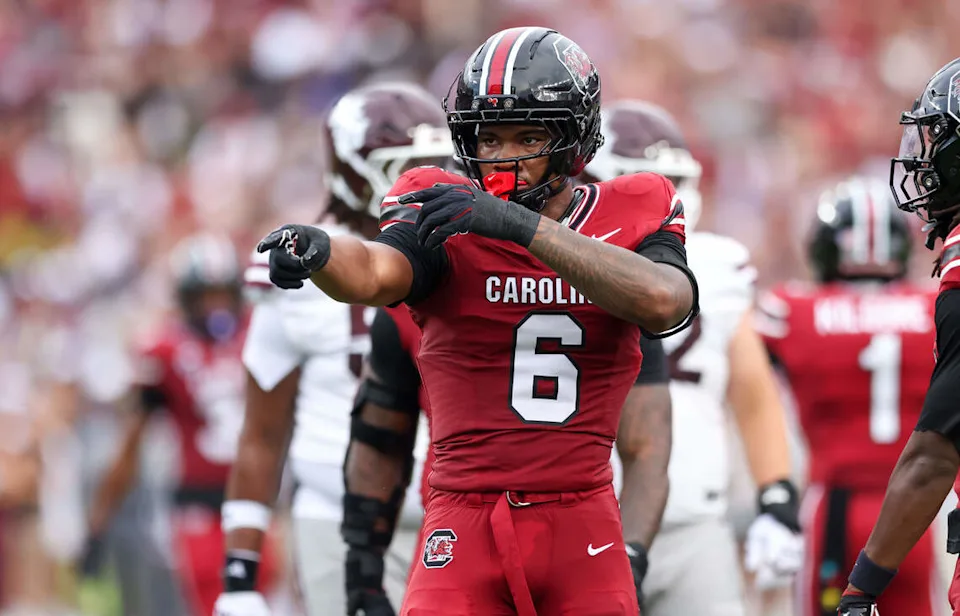
Dylan Stewart, EDGE, South Carolina
Dylan Stewart’s first step is an established part of his profile. South Carolina describes him as explosive with a strong lower body, and his production before this season gives evaluators more than a workout projection.
In 2025, Stewart recorded 12 tackles for loss, 4.5 sacks and three forced fumbles. Against LSU, his strip-sack led to a Nick Barrett touchdown return. Against Kentucky, he forced two fumbles.
Those are useful starting points for a film review because they show disruption beyond simply reaching the quarterback. The next question is how consistently Stewart creates those opportunities across his full set of rushes.
A 10-yard split can measure his acceleration. Film can show whether his get-off forces a tackle to open early, whether he has a counter when the first move stalls and how he finishes after contact. Those details should carry into Indianapolis with him.
Greg Johnson, OL, Minnesota
Greg Johnson belongs in this discussion because he has already handled more than one interior assignment. Minnesota’s 6-foot-6, 325-pound lineman moved from guard to center for the September 26 win at Washington and earned Outland Trophy National Player of the Week honors.
The SI top 100 board ranks him No. 15 overall. That is an established place near the top of the class, not evidence of an overlooked prospect waiting to emerge.
This kind of positional flexibility has mattered for offensive linemen heading into past drafts too. Scouts tend to weigh how a lineman performs across multiple spots along the line just as heavily as any single workout number, since it speaks to football IQ and the ability to adjust assignments on short notice. Versatility and run blocking helped Kenyon Green strengthen his draft stock at Texas A&M, according to Prime Time Sports Talk. Prime Time Sports Talk’s coverage of that draft class made a similar point about linemen who log time at more than one spot. Johnson’s work at guard and center makes those same qualities worth examining, although his evaluation should stand on his own performances.
Minnesota’s report on the Washington game provides a concrete example. Johnson earned a 92.8 run-blocking grade from Pro Football Focus, and the school reported that he had not allowed a quarterback pressure through that point in the season.
That September snapshot is not a full-season verdict. It identifies a strong performance to revisit alongside his later games, especially when judging balance, hand placement and recovery against different defensive fronts.
The bench press will produce another number. His work across two positions offers a broader test of whether his strength translates into dependable interior blocking.
Chris Cole, LB, Georgia
Chris Cole has supplied specific games worth revisiting. Against Oklahoma on September 26, he made eight tackles, recorded a sack and recovered two fumbles, returning one 85 yards for a touchdown.
At Alabama on October 10, he added eight tackles, 2.5 tackles for loss, a sack and two pass breakups. That combination gives evaluators examples of his work attacking the line and affecting passing plays.
The distinction between recognition and athleticism matters here. Cole can identify formations before the snap, but reading a guard’s first step and reacting to the play happen after it.
A shuttle time measures change-of-direction ability under controlled conditions. Cole’s game film offers the harder test: how quickly he recognizes the assignment, takes the right angle and arrives in position to finish. His Oklahoma and Alabama performances give that discussion substance beyond a projected testing number.
Sammy Omosigho, LB, UCLA
Sammy Omosigho’s case is built on production, not just a description of his range. Against Purdue on September 19, the UCLA linebacker made 12 tackles, including 11 solo stops, with two sacks and two forced fumbles.
He earned Big Ten Defensive Player of the Week honors for that performance. By UCLA’s November 11 Walter Camp Award announcement, he had five forced fumbles and was one of the award’s 20 semifinalists.
The Purdue game gives evaluators a clear place to examine how he gets to the ball and what happens when he arrives. Tackles show involvement; sacks and forced fumbles add evidence of plays that can change a possession.
His pursuit angles and ability to handle traffic still deserve attention across complete games. A fast run in Indianapolis would complement that work, but it would not explain how he diagnoses a cutback or avoids getting caught behind a block.
Omosigho’s regular-season finale against USC is scheduled for November 28. There is still evidence to add before his college evaluation is complete.
Jamari Johnson, TE, Oregon
Jamari Johnson brings a receiving foundation that should remain central to his evaluation. In 2025, his first season at Oregon, he caught 32 passes for 510 yards and three touchdowns while making 10 starts.
That production gives scouts more to examine than his frame or a projected 40 time. His receiving film can show how he finds space, presents a target and handles contact at the catch point.
Blocking is a separate question. SI’s assessment identifies it as an area Johnson needs to improve, rather than the trait that already makes him a complete tight end.
That makes his assignments in the run game especially important to review. Holding an edge, securing a backside defender and sustaining contact require technique as well as size. A bench-press total cannot settle whether he performs those jobs consistently.
The same principle runs through all five evaluations. Stewart’s disruption, Greg Johnson’s versatility, Cole’s impact plays, Omosigho’s ball production and Jamari Johnson’s receiving work give the testing discussion its foundation.
When the combine wraps up in March, the measurements should sharpen those evaluations. They should not erase the games that made these prospects worth watching.

NFL Draft Diamonds was created to assist the underdogs playing the sport. We call them diamonds in the rough. My name is Damond Talbot, I have worked extremely hard to help hundreds of small school players over the past several years, and will continue my mission. We have several contributors on this site, and if they contribute their name and contact will be in the piece above. You can email me at nfldraftdiamonds@gmail.com