
The Stopwatch Trap: Why Obsessing Over 40-Yard Dash Times Is Football’s Worst Scouting Habit
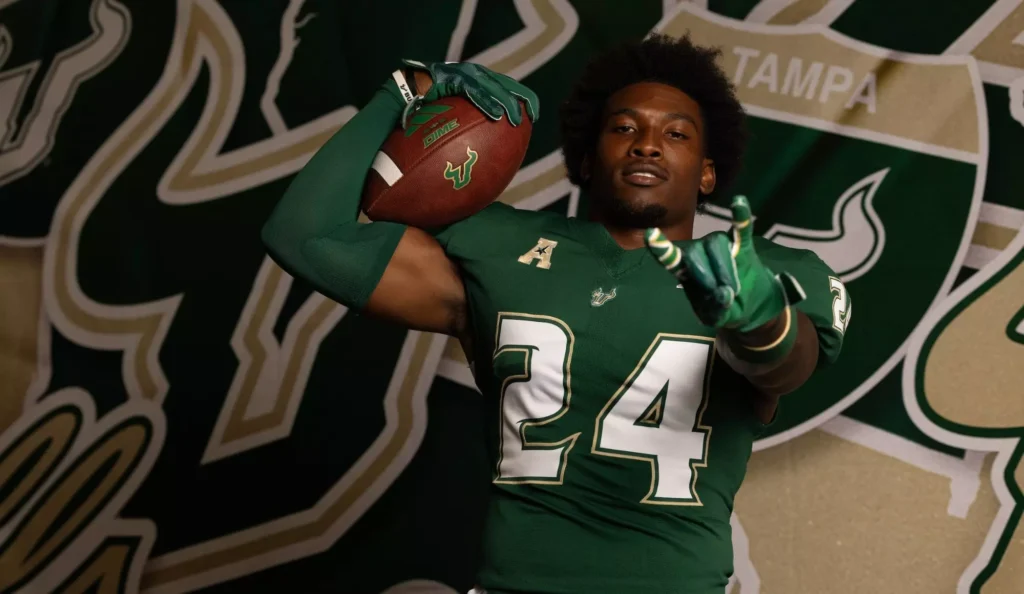
Every spring, the football world loses its collective mind over a four-second sprint in spandex.
A player can spend three or four years dominating elite college competition, breaking tackles, stacking 1,200-yard seasons, and taking over games on Saturdays. Yet the moment he runs a 4.58 instead of a 4.42 in a sterile indoor stadium, draft boards plummet, pundits panic, and fans start slapping him with the dreaded “system player” label.
Writing off a proven, hyper-productive football player because of a 40-yard dash time isn’t just lazy scouting, it completely misunderstands how the sport is actually played.
Track Speed vs. Game Speed
The 40-yard dash measures one very specific thing: how fast an athlete can run in a straight line without pads, without a ball, and without eleven massive human beings trying to take his head off.
Football is rarely played in a straight line. Receivers don’t run 40 yards unbothered; they have to beat press coverage at the line of scrimmage, sink their hips at the top of a route, track a ball over their shoulder, and make a contested catch through contact. Running backs don’t get a clean runway; they have to press the line of scrimmage, read leverage, make a sudden lateral cut, and accelerate through a closing crease.
A player with elite short-area quickness, body control, and spatial awareness will look like the fastest guy on the field on Saturday afternoon, even if his straight-line track speed is merely average.
The Art of Technique and Instincts
Production at a high level doesn’t happen by accident. If a player is consistently torching top-tier defenses despite lacking “burner” speed, it means he has already mastered the harder parts of the game.
- Route Running & Leverage: A receiver who runs a 4.55 but knows how to manipulate a cornerback’s blind spot and create separation at the break point will always get open more consistently than a 4.32 track star who rounds off his cuts.
- Vision & Anticipation: Great defenders and running backs see plays develop a fraction of a second before everyone else. Starting your sprint half a second earlier because you diagnosed the play beats running a tenth of a second faster every single time.
- Play Strength & Contact Balance: Speed dies the moment someone grabs your jersey. Productive players know how to play through contact, keep their legs churning, and finish runs—traits a stopwatch can never measure.
History Is Full of “Slow” Legends
If front offices actually let the 40-yard dash dictate their entire draft board, the Hall of Fame would look very different.
Jerry Rice—widely considered the greatest football player to ever live—famously ran in the high 4.5s (and by some accounts, the 4.6s). Anquan Boldin ran a 4.71 at the combine and went on to catch over 1,000 passes and bully defensive backs for 14 years. Cooper Kupp ran a 4.62 before winning a Triple Crown and a Super Bowl MVP. On the defensive side, players like Terrell Suggs saw their stock dip after sluggish combine workouts, only to become a perennial Pro Bowler because their pad-level power and instincts were unmatched.
Meanwhile, the history of the NFL is littered with sub-4.3 speedsters who couldn’t catch, couldn’t tackle, or couldn’t read a playbook.
Trust the Tape
The 40-yard dash was originally created to measure how fast a player could run downfield on punt coverage, roughly the distance of a punt. Somewhere along the way, it turned into the ultimate litmus test for athletic viability.
Testing numbers have their place as a tiebreaker or a way to confirm what you already see on film. If a guy looks slow on tape and runs slow in shorts, you have a problem. But when a player has a mountain of film showing him dominating high-level competition, ignoring that evidence because of a stopwatch is malpractice.
At the end of the day, games aren’t won in underwear on a track. They’re won in pads, between the whistles, by guys who know how to play football.

NFL Draft Diamonds was created to assist the underdogs playing the sport. We call them diamonds in the rough. My name is Damond Talbot, I have worked extremely hard to help hundreds of small school players over the past several years, and will continue my mission. We have several contributors on this site, and if they contribute their name and contact will be in the piece above. You can email me at nfldraftdiamonds@gmail.com