
Top 5 NFL Players Who Love to Gamble
The NFL has one of the strictest gambling policies in professional sport, yet for as long as the league has existed, some of its players have found the pull of a wager impossible to resist. Long before sports betting apps sat in every pocket, Hall of Famers were being suspended for placing $100 bets with bookies. Today, with gambling ads blanketing every broadcast and legal sportsbooks operating in most states, the temptation has never been greater or easier to act on.
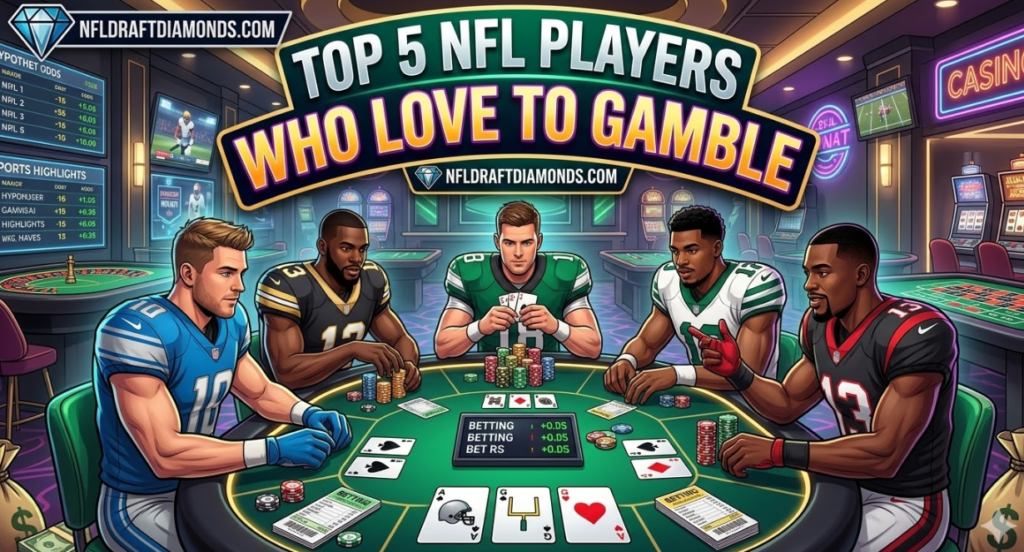
Some players have faced season-long banishments. Others have lost more money on a single night than most fans earn in a decade. Before we get into the stories, if you want to experience the other side of the table, try live dealer blackjack online at Moonbet, where the house edge is near zero and the action is 24/7.
These are the five NFL figures whose gambling stories stand out above the rest — documented, verified, and in some cases genuinely jaw-dropping.
Quick Comparison
| Player | Position | Biggest Win | Biggest Loss / Consequence |
|---|---|---|---|
| Paul Hornung | RB / K, Packers | Up to $500/game; net +$1,500 one season | Full-season suspension, 1963 |
| Art Schlichter | QB, Colts | Brief on-field career success | $489K lost in one winter; prison time |
| Calvin Ridley | WR, Falcons/Titans | None documented (bet to win) | $1,500 stake cost him $11M+ in salary |
| Jameson Williams | WR, Lions | College football bets (undisclosed) | 4-game suspension, 2023 season |
| Isaiah Rodgers | CB, Colts | Undisclosed | 100+ bets; indefinite suspension 2023 |
1. Paul Hornung — The Golden Boy Who Bet on the Packers to Win
Paul Hornung was the most glamorous player in the NFL. He won the Heisman Trophy at Notre Dame, went first overall to the Green Bay Packers, scored a record 176 points in a single season, and was named league MVP in 1961. He was also quietly betting on football throughout the height of his career.
Commissioner Pete Rozelle launched a league-wide investigation in 1962. When the spotlight landed on Hornung, he did not deny it. He had been placing bets on college and NFL games from 1959 through 1961, wagering between $100 and $500 per game, with a maximum of $500 on any single NFL contest. Rozelle’s investigation confirmed that Hornung had never once bet against the Packers — every wager was on his own team to win. In his most profitable season he came out ahead by $1,500 in total. He did not get rich gambling. He got suspended for an entire year.
On April 17, 1963, Rozelle handed Hornung and Detroit Lions defensive tackle Alex Karras indefinite suspensions. It was the same punishment Karras received despite his bets being even smaller — six wagers of $50 to $100. Rozelle made his position clear: the violations were not casual but continuing, and examples had to be made of two of the league’s biggest stars.
Both men were reinstated in March 1964 before the new season. Hornung went on to win two more championships with Vince Lombardi’s Packers and was eventually inducted into the Pro Football Hall of Fame in 1986. He died in November 2020. The NFL’s gambling problem did not die with him — it just moved to smartphones.
2. Art Schlichter — The Cautionary Tale That Still Echoes
No story in NFL history illustrates the full destruction a gambling addiction can cause better than Art Schlichter’s. The Baltimore Colts took him fourth overall in the 1982 draft out of Ohio State, where he had been one of the most decorated quarterbacks in the country. The addiction was already running in parallel with his talent.
During the 1982 NFL players’ strike, with games postponed and downtime filling his schedule, Schlichter began betting heavily on basketball. Between the winter of 1982 and the spring of 1983 alone, he lost $489,000. The debt mounted so fast that bookmakers began threatening him. In March 1983 he went to the FBI, handed over information that got the bookies arrested on federal charges, and simultaneously asked the league for help — fearing he might be coerced into fixing games to pay what he owed. He admitted to betting on ten NFL games. Rozelle suspended him for the 1983 season and reduced the penalty to thirteen months after Schlichter agreed to seek treatment.
He never came back to the level his draft position promised. His NFL career amounted to just thirteen appearances across four seasons. The gambling never stopped. Schlichter later estimated he had stolen approximately $1.5 million from friends, family, and strangers over the years to fund the addiction — writing bad checks, running con schemes, and taking money from people who trusted him. He spent ten years in federal prison from 2011 through 2021 on bank and wire fraud charges. He has since been diagnosed with early-onset Parkinson’s disease and dementia.
His story was cited by journalists and league officials every time a new player was caught betting after him — with Calvin Ridley’s 2022 suspension prompting multiple reporters to revisit Schlichter’s case as a warning of where things can go.
3. Calvin Ridley — $1,500 in Bets, $11 Million in Lost Salary
The numbers make this case almost impossible to believe. Calvin Ridley, then a wide receiver with the Atlanta Falcons, placed $1,500 in total wagers on NFL parlays over a five-day stretch in November 2021. He was not with the team at the time — he had stepped away from football to address his mental health. He was on the non-football injury list, out of state, watching games on TV, and he downloaded a betting app.
“I downloaded the app sitting there not knowing that I was breaking a rule or anything,” Ridley told ESPN years later. “Those were the only two NFL games I bet.”
The NFL’s investigation found no inside information was used and no game was compromised. Ridley bet on the Falcons to win. He cooperated fully with investigators. None of it mattered. Commissioner Roger Goodell suspended him for the entire 2022 season — the same punishment handed to players in 1963 who had been betting for years. The salary Ridley missed as a result came to more than $11 million.
He tweeted his reaction at the time: the total amount bet was $1,500, he said he had no gambling problem, and he was genuinely stunned by the severity. He was later reinstated in March 2023, traded to the Jacksonville Jaguars, and eventually signed with the Tennessee Titans. He remains one of the clearest examples of the gap between the NFL’s posture toward gambling integrity and its simultaneous embrace of sportsbook advertising revenue.
4. Jameson Williams — A Technical Rule, a Costly Lesson
If the Ridley case seemed disproportionate, Jameson Williams’s situation took the irony even further. The Detroit Lions wide receiver, taken 12th overall in the 2022 draft, was suspended for betting on college football games — not NFL games — while physically inside the Lions’ practice facility in Allen Park, Michigan.
His agency spelled out the specifics directly: the violation was not for the act of gambling but for the location in which it occurred. Had Williams placed the identical bets from his couch at home, it would have been permitted under NFL rules. The league forbids any wagering of any kind from team facilities, a rule that existed because the league needed to ensure no connection between team access and betting activity. Williams said he was unaware of the restriction. He did not appeal.
His initial six-game suspension was later reduced to four games after the NFL and NFLPA agreed on revised policy terms that reduced penalties for non-NFL betting at team facilities. The change was specific enough that Williams was reinstated two weeks early. He returned in time to catch a 45-yard touchdown pass against Tampa Bay in the game he became eligible to play.
Williams has gone on to become one of the Lions’ top offensive weapons. He has spoken openly about the experience and described it as a lesson he took seriously. The NFL, for its part, had placed a sports betting bar inside Ford Field — the stadium where the Lions play — while simultaneously punishing its own player for making a college football bet from the practice facility down the road.
5. Isaiah Rodgers — 100+ Bets, Including One on His Own Teammate
The 2023 NFL gambling scandal involved more suspended players than any period since the league’s post-PAPSA era began in 2018, and the most serious individual case among that group belonged to Indianapolis Colts cornerback Isaiah Rodgers. He was suspended indefinitely in June 2023 after an NFL investigation determined he had placed upward of 100 bets on NFL games during the 2022 season.
The detail that cut through was this: among those bets was a $1,000 prop wager on running back Jonathan Taylor — Rodgers’s own teammate. There was no suggestion that Rodgers had taken any action to affect the outcome of a game, and the league found no evidence of game manipulation. But the scope and frequency of the betting, and the inclusion of a bet on a player he practiced alongside every week, placed the violation in a different category from the other suspensions issued that spring.
The Colts waived Rodgers immediately after the suspension was announced. He was not among the five players reinstated in April 2024 when the league cleared several others from the same wave of punishments. His case remained under review. He eventually signed with the Philadelphia Eagles, who held his rights pending any reinstatement decision from the league.
His case stood as the sharpest illustration of why the NFL draws such a hard line on player betting. The concern is never primarily about the sums involved. It is about what access to a locker room, to injury reports, to practice schedules, and to individual players could mean if the wrong information reaches the wrong people.
The Pattern Runs Deeper Than Any Single Player
Across six decades, from Hornung’s $500 bets in 1963 to the 2023 wave of smartphone-era suspensions, the throughline is the same: the NFL’s biggest gambling problem is not the players who bet large amounts with criminal intent. It is the players who cannot separate the professional world they work in from the betting culture the league itself now promotes. The NFL generates billions from sportsbook partnerships. Its stadiums contain licensed betting facilities. Its broadcasts run back-to-back gambling advertisements.
The players who paid the steepest prices — Ridley losing $11 million in salary over $1,500 in bets, Williams suspended for a wager he could legally have placed from his living room — were caught in the tension between those two realities. If you want to be on the right side of that table, the smarter move is to keep gambling and professional football entirely separate. Or, better yet, play live dealer blackjack online at Moonbet — where the only edge in play is the one in your strategy.
NFL Draft Diamonds was created to assist the underdogs playing the sport. We call them diamonds in the rough. My name is Damond Talbot, I have worked extremely hard to help hundreds of small school players over the past several years, and will continue my mission. We have several contributors on this site, and if they contribute their name and contact will be in the piece above. You can email me at nfldraftdiamonds@gmail.com