
The Tua vs. Herbert Debate: What We Get Wrong About QB Development
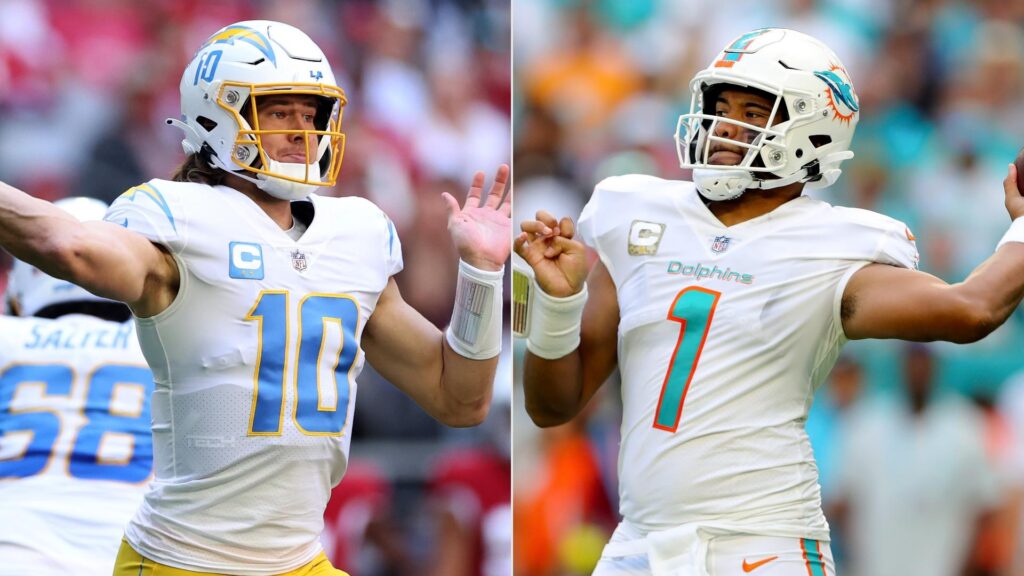
Hello everyone, it’s Tom. As a writer who has covered the NFL for years, I’ve seen my share of pointless bar arguments. But for the better part of five years, no debate has been more divisive, more entrenched, or more fascinating to me than “Tua vs. Herbert.”
It’s the ultimate NFL “what if,” a sliding doors moment frozen in time. In the 2020 NFL Draft, the Miami Dolphins, armed with the 5th overall pick, selected Alabama quarterback Tua Tagovailoa. One pick later, the Los Angeles Chargers snagged Oregon’s Justin Herbert.
Since that day, their careers have been locked in a constant, furious battle—mostly by fans and media. Herbert immediately looked like a Greek god, a 6’6″ prototype with a cannon arm, winning Offensive Rookie of the Year. Tua, meanwhile, struggled with injuries and a shaky environment, leading many to label the Dolphins’ pick a historic blunder.
Then, a funny thing happened. Tua, united with offensive wunderkind Mike McDaniel, suddenly became an MVP candidate, leading the league in passer rating (2022) and passing yards (2023). The debate raged on.
But now, as we stand here in 2025, the narrative has soured again. Tua and the McDaniel offense have looked mortal. Herbert, conversely, is finally getting some stability under a new regime. The debate is back, and I’m here to tell you we’ve been having the wrong conversation all along.
We’re obsessed with “who is better.” The real question is: “What have these two organizations done to their quarterbacks?”
This debate isn’t about Tua vs. Herbert. It’s about environment vs. isolation. It’s about what we get fundamentally wrong about how quarterbacks are made, and unmade, in the modern NFL.
Case Study 1: Tua and “The System”
To understand Tua Tagovailoa, you have to understand the Mike McDaniel offensive ecosystem. It wasn’t just a playbook, it was a life-support system designed to amplify all of Tua’s strengths and completely mask his weaknesses.
What are Tua’s strengths? Uncanny accuracy, a lightning-fast release, and elite anticipation. What are his perceived weaknesses? A-plus arm strength and a penchant for holding the ball, which led to devastating injuries.
So, what did McDaniel build?
- He imported Tyreek Hill and paired him with Jaylen Waddle, creating the fastest wide receiver duo in NFL history. This wasn’t a luxury, it was a prerequisite.
- He built an offense based on RPO (Run-Pass Option), pre-snap motion, and, most importantly, getting the ball out of Tua’s hands immediately.
The stats don’t just support this, they scream it. In 2023, Tua led the entire NFL with the fastest average time to throw. The ball was snapped and it was gone. This wasn’t just a good idea, it was a survival mechanism to protect him from his own offensive line.
The offense was a masterpiece of schematic design. It created massive yards-after-catch (YAC) opportunities. Tua was leading the league in passing yards, but many of those were 5-yard slants that Hill or Waddle took for 60. It was brilliant.
But here’s the catch: What happens when the system’s perfection starts to crack? What happens when, as we saw with Tyreek Hill’s season-ending injury in 2024, you remove the queen from the chessboard? What happens when defenses finally have enough film to adapt?
The system that looked like an invincible cheat code now looks rigid. The debate around Tua is no longer “Is he elite?” It’s “Is he a product of a system that has been figured out?”
Case Study 2: Herbert and “The Chaos”
Now, let’s cross the country to Los Angeles and look at the polar opposite. If Tua has lived in a carefully curated biosphere, Justin Herbert has been surviving in a chaotic wilderness.
The man with one of the most gifted arms in NFL history has been the victim of staggering organizational instability. While Tua has had McDaniel, Herbert is now on his fourth offensive coordinator in Greg Roman.
Let’s recap his journey:
- 2020 (Rookie Year): Bursts onto the scene under Shane Steichen. Looks like a Hall of Famer.
- 2021-2022 (Joe Lombardi): Strapped into an inexplicable “death-by-a-thousand-checkdowns” offense. Fans and analysts were furious, watching a guy with a rocket launcher being forced to play like a peashooter.
- 2023-2024 (Kellen Moore / Greg Roman, Year 1): More change, and then the bottom fell out. In the 2024 offseason, the Chargers blew up his entire supporting cast. They cut veteran star Mike Williams, traded his long-time security blanket Keenan Allen, and let star running back Austin Ekeler walk.
Herbert, unlike Tua, was stripped bare. He was left with a rookie receiver and a collection of journeymen. His offensive line was a mess. He was, by all accounts, asked to single-handedly carry the “burden” of the entire franchise.
It was the NFL equivalent of asking a world-class chef to cook a gourmet meal with an empty pantry. You can’t just try a demo of an offense, you have to live in it. And Herbert’s home has been in constant renovation, with the walls being torn down around him.
Only now, in 2025, is he getting a second consecutive year in the same system. We are five years into his career, and he is just now getting the basic stability that Tua has had from day one with McDaniel.
The Numbers Tell the Story
If you just look at the box score, the debate is a wash. Their career passer ratings are nearly identical. But when you look at the how, the difference is staggering.
I compiled some advanced data from the 2023 season, when both were healthy and operating in their defined systems. The contrast is a perfect illustration of their opposing philosophies.
| Advanced Metric (2023 Season) | Tua Tagovailoa | Justin Herbert | What This Means |
| Avg. Time to Throw (TTT) | ~2.40s (Fastest in NFL) | ~2.85s (Among slowest) | Tua’s system was all about getting the ball out. Herbert’s system (and lack of weapons) forced him to hold it and create. |
| Intended Air Yards (IAY) | 8.6 (Top 5) | 8.1 (Above Avg) | Both pushed the ball, but Tua’s system schemed guys open deep. |
| Yards After Catch / Cmp (YAC/C) | 5.9 (Top 3) | 4.7 (League Avg) | This is the key. Tua’s passes traveled far, and then his elite weapons added massive yards. Herbert was getting average help. |
Tua was the trigger man for a high-speed, perfectly-timed track meet. Herbert was a one-man-band, trying to play every instrument at once.
Conclusion: It’s the Environment, Stupid
So, who is “better”? I’ll be honest, I think it’s the wrong question.
If you put Justin Herbert in Miami with McDaniel, Hill, and Waddle, I believe he’d have an MVP trophy. His arm talent in that “get-it-out-quick-and-let-them-run” system would be unstoppable.
If you put Tua in Los Angeles, with a rotating door of coaches and a practice squad-level receiving corps… I genuinely worry he wouldn’t have survived. His precision and timing would have been useless behind a collapsing pocket, and his physical limitations would have been brutally exposed.
We are obsessed with grading the quarterback as an individual. But we consistently, stubbornly refuse to grade the organization’s ability to develop that quarterback.
The Tua vs. Herbert debate isn’t about two players. It’s a definitive lesson in the value of stability, supporting cast, and schematic design. Tua was given every possible tool to succeed, crafted specifically for him. Herbert was given a toolbox and told to build the entire house himself.
Before we anoint one and bury the other, perhaps we should look at the architects.
What’s your take?
Do you believe Herbert’s raw talent makes him the clear winner, regardless of situation? Or has Tua’s success, even if system-dependent, proven he was the right pick for Miami? Let me know your thoughts.
Tom

NFL Draft Diamonds was created to assist the underdogs playing the sport. We call them diamonds in the rough. My name is Damond Talbot, I have worked extremely hard to help hundreds of small school players over the past several years, and will continue my mission. We have several contributors on this site, and if they contribute their name and contact will be in the piece above. You can email me at nfldraftdiamonds@gmail.com